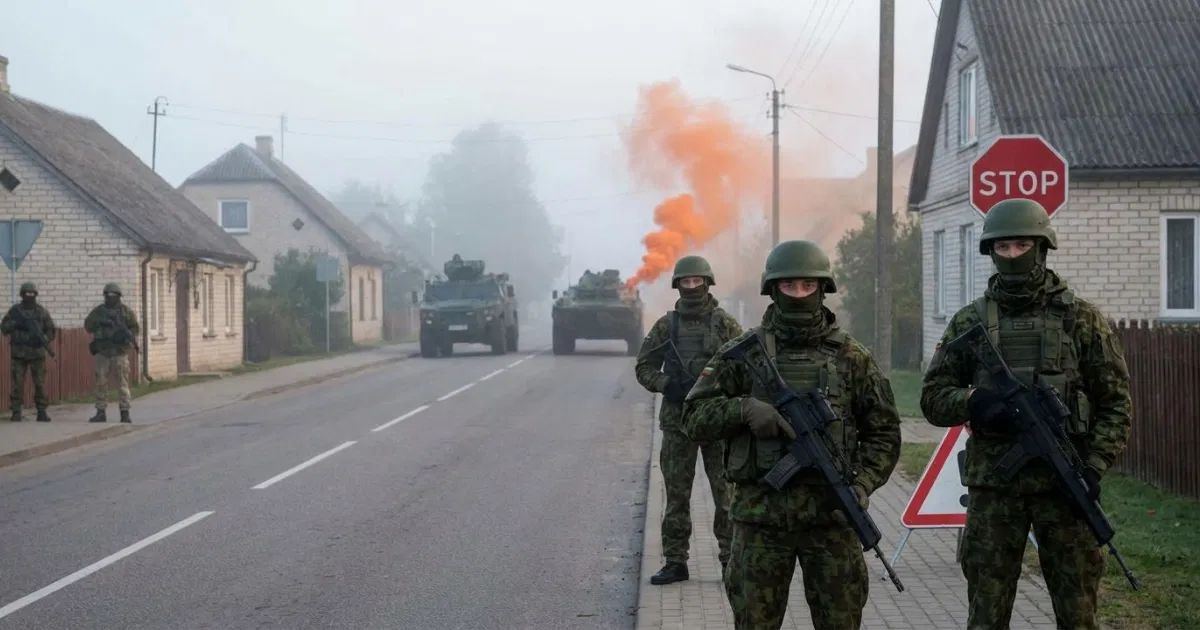

Paramilitary war exercises in Lithuania: Volunteers prepare for possible Russian invasion
At least 1,500 paramilitary personnel gathered late last month in the northeastern Lithuanian city of Utena, taking positions in government buildings and around critical infrastructure to rehearse for the scenario many in the border town fear: a Russian invasion.
Dressed in military uniforms and carrying rifles loaded with blank rounds, members of the Lithuanian Riflemen’s Union (LRU) — a state-funded paramilitary organization — spent several days training to repel a possible hostile attack. According to the Wall Street Journal, which observed the LRU’s activity, forces arrived in Utena to take part in some of the largest war games in the group’s history, with ordinary Lithuanian citizens taking up arms and devoting evenings and weekends to the preparation (Wall Street Journal).
LRU leaders and Lithuanian officials say there is no immediate threat of a Russian invasion because much of the Russian military remains engaged in Ukraine. Still, the group, which is supported by the country’s armed forces, insists the small Baltic nation cannot take that risk.
“We prepare because you can’t just sit and wait with folded hands,” said Lieutenant Colonel Linas Indzelis, commander of the LRU. Members of the organization describe sacrificing personal and professional time to learn military skills as an investment in the country’s security and in the safety of the next generation. Company commander Renda Vaitciuliene, who joined the LRU seven years ago, regularly leaves her three children at home to attend exercises. “I think they are proud of what we do,” she said.
Across Eastern Europe, groups offering military training to civilians — like the LRU — have seen a large rise in membership since Russia’s full-scale invasion of Ukraine in 2022. Western officials accuse Russia and its ally Belarus of conducting sabotage and destabilizing operations — so-called hybrid warfare — across Europe; the Kremlin and Belarus have repeatedly denied involvement in such attacks.
Lithuanian authorities point to an escalation of hybrid tactics this year: nearly 600 balloons carrying smuggled cigarettes entered Lithuania from Belarus so far this year, according to the Lithuanian State Border Guard — almost three times the total for all of 2024. Those balloons forced the temporary closure of Vilnius airport several times in October and disrupted thousands of passengers. The Lithuanian government has labeled the incidents part of a “hybrid attack” aimed at destabilizing the country; Belarus denies involvement (Lithuanian State Border Guard).
The LRU, a force with roots in Lithuania’s early 20th-century struggle for independence, now counts about 17,000 members — nearly as many as the country’s regular armed forces, which number roughly 20,000. In the event of an invasion, the paramilitary group would be fully integrated into the national army. Defense analysts say volunteers and reservists will be critical in the opening hours and days of any conflict, acting as a first line of defense before NATO reinforcements can arrive.
During the recent exercises in Utena, a few minutes after midnight one night, the LRU set up multiple checkpoints around the town to halt traffic and impose a mini lockdown on its 34,000 residents — a rehearsal of life under martial law. Shortly after 7 a.m., simulated explosions and gunfire echoed through otherwise quiet residential streets. Yellow and red smoke grenades, standing in for grenade bursts, were set off near power facilities across the town. “We heard explosions,” said a Ukrainian resident of Utena. “It’s very frightening because we lived very peacefully here and now I hear what I heard in Ukraine.”