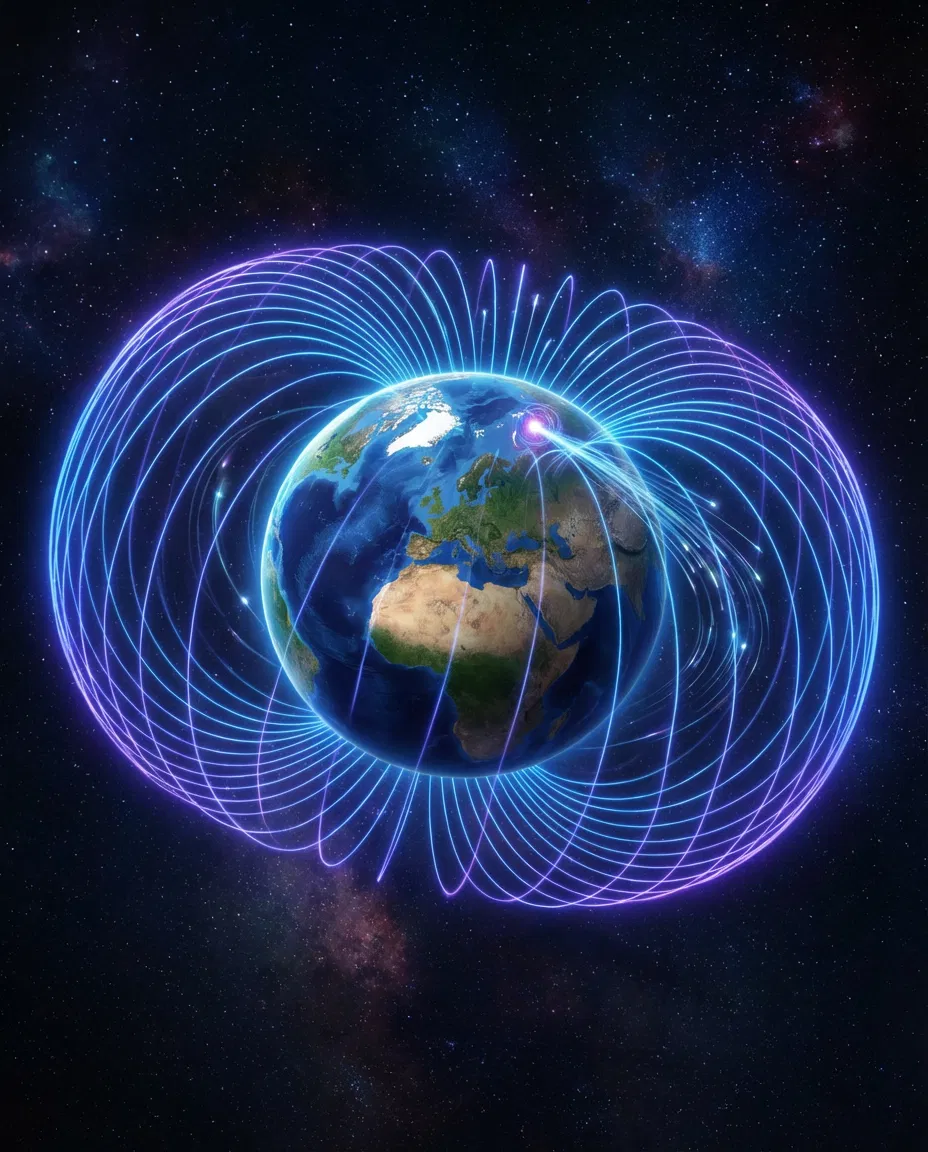

Scientific agencies have confirmed a new position for Earth’s magnetic north pole after more than 190 years of continuous drift. The pole has travelled over 2200 km from the Canadian Arctic toward Siberia, creating global implications for navigation technologies and safety critical systems.
The latest update to the World Magnetic Model released by NOAA and the British Geological Survey provides the official coordinates for the years ahead. The report verifies that the pole is still moving toward Russia, although its speed has eased compared with the rapid pace documented in the 1990s.
Millions of devices and operations depend on precise magnetic readings. Aviation routes, military equipment, underwater navigation platforms, and digital mapping systems rely on accurate models to function without error. Even small directional deviations may jeopardize missions in environments that demand precision such as Arctic airspace or deep sea transit corridors.
Movement toward the Russian Arctic places the magnetic pole closer to northern Russia than to Canada for the first time in modern records. Internal geodynamic processes drive this shift, which scientists have monitored closely as the pole now enters an area that has never hosted it in documented history.
Researchers report that the pole’s current motion of about 35 km each year marks a significant decline from past speeds of up to 60 km annually. This deceleration is the greatest ever observed, prompting renewed interest in the deep Earth mechanisms that govern magnetic field behavior nearly 3000 km below the surface.
Experts emphasize that there is no evidence suggesting an imminent reversal of the magnetic poles. Such events unfold over hundreds of thousands of years and remain absent from the present trend. The updated World Magnetic Model will remain valid through 2029 unless unexpected phenomena force an earlier revision.