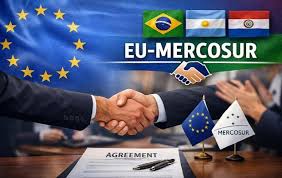

Historic Signing of the EU Mercosur Trade Agreement
The European Union and Mercosur member states signed a landmark free trade agreement in Asuncion, Paraguay, marking the end of more than 25 years of negotiations and the beginning of one of the largest trade zones in the world. Representing the EU, European Commission President Ursula von der Leyen and European Council President Antonio Costa formalized the deal, which will cover a market of approximately 700 million consumers.
A Milestone Agreement According to EU Leadership
Antonio Costa emphasized that the EU Mercosur agreement arrives at the perfect moment, describing the long negotiation journey as essential for strengthening global trade ties. Ursula von der Leyen stated, Today after 25 years of work we are writing history, highlighting that the deal extends beyond trade by promoting economic cooperation, open markets, sustainability, and shared geopolitical commitments.
Projected Economic Boost for Both Regions
The Commission expects EU exports to Mercosur to rise by up to 50 billion euros, while Mercosur exports to the EU could increase by 9 billion euros. Von der Leyen noted that removing billions of euros in tariffs will generate real value, real growth, real jobs across both sides of the Atlantic.
Commitment to Sustainability and Climate Goals
The agreement introduces legally binding commitments aimed at achieving climate neutrality by 2050. It also strengthens political dialogue between the two regions on sustainability, equality, peace, and security, reflecting shared values and mutual trust.
Safeguards for European Farmers
Addressing concerns from the agricultural sector, the agreement includes strong safety nets to protect sensitive farming sectors and farmers incomes. It also secures 350 geographical indications and ensures compliance with EU food safety standards for all Mercosur imports.
Next Steps Toward Implementation
The Partnership Agreement requires ratification by all EU member states, while the Interim Trade Agreement will be reviewed by the European Parliament and the Council. Once approved, it will be provisionally applied until full ratification is complete.
What the Agreement Means for Greece
The European Commission outlined several benefits for Greece, including easier business operations for companies, lower service provision costs, increased export potential, and greater demand for premium Greek food products in Mercosur markets.
Trade as a Driving Force in the Greek Economy
Exports support 631000 jobs in Greece, representing 1 in 8 positions. Total trade between Greece and Mercosur currently stands at 2.6 billion euros, and the agreement will eliminate tariffs on 91% of all products, boosting Greek exports significantly.
New Opportunities for Greek Farmers
Mercosur currently imposes tariffs up to 55% on EU agricultural products, limiting market access. The agreement will remove these barriers, creating new export opportunities for Greek farmers.
Protection of Authentic Greek Products
The agreement protects 344 European food and drink items from imitation, including 21 Greek geographical indications. This protection is expected to increase sales and premium pricing for Greek products.
Safeguarding Farmers in Case of Market Disruption
The agreement includes quotas on agricultural imports from Mercosur to prevent harmful market shifts. It also introduces a safeguard clause to protect EU farmers from sudden import surges, a first for an EU trade agreement.
Expanding Services Between Greece and Mercosur
Greek service exports to Mercosur total 1.6 billion euros annually. The agreement opens further opportunities in finance, telecommunications, transport, digital trade, and environmental services.
Supporting Greek Small Businesses
With 97% of Greek exporters being small businesses, the agreement reduces costs, simplifies procedures, improves access to public tenders, and provides additional support through small business coordinators.
Green Light for the Agreement Despite Opposition
EU ambassadors approved the deal, though France, Poland, Austria, Ireland, and Hungary voted against it. France remains firmly opposed, citing strong political rejection at home due to the perceived threat to farmers.
Controversy and Protests Across Europe
Farmers across Europe are protesting the agreement, fearing rising production costs and reduced competitiveness. Critics argue that the EU is sacrificing European agriculture to strengthen trade with Latin America.
Understanding Mercosur
Mercosur, the Southern Common Market, is a South American trade bloc founded in 1991 with members Argentina, Brazil, Paraguay, and Uruguay. It represents one of the largest agricultural markets globally and has been in negotiations with the EU for two decades.
EU Objectives Behind the Agreement
The deal includes the largest tariff reduction in EU history, eliminating 4 billion euros in annual duties. It promotes trade in vehicles, machinery, wines, and spirits while allowing more agricultural imports from South America. It also strengthens access to critical resources such as lithium, copper, iron, and cobalt.
Supporters of the Agreement
Countries including Germany and Spain argue that Mercosur offers a strategic alternative to reliance on China, especially for key minerals. The Commission emphasizes that the agreement removes the highest volume of tariffs ever achieved in an EU deal.
Critics of the Agreement
France, the largest beef producer in the EU, insists the deal threatens European agriculture. Environmental groups like Friends of the Earth call it catastrophic for the climate due to fears of increased deforestation, particularly in the Amazon, driven by rising agricultural exports to Europe.