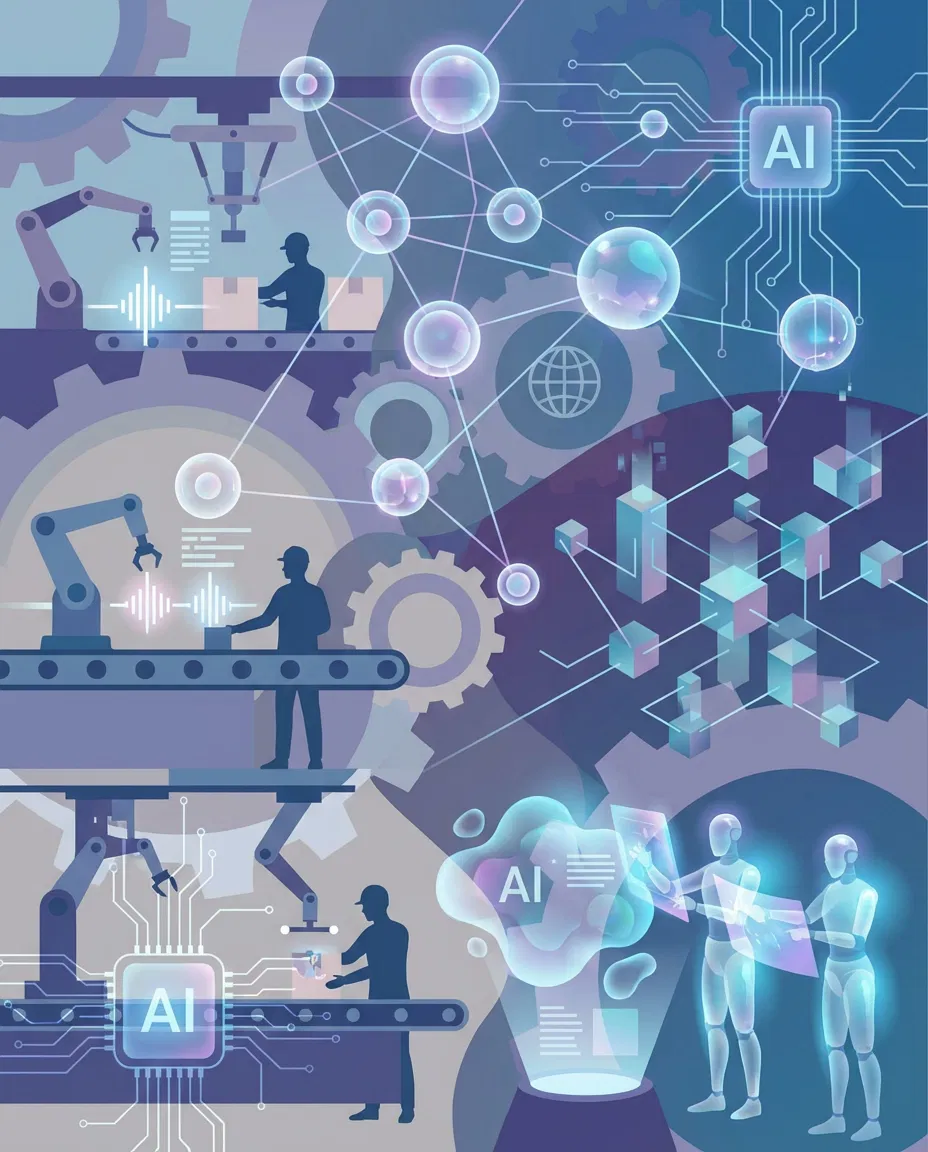

AI emerged in 2025 as a decisive force reshaping the global economy rather than a distant threat. Economic restructuring accelerated as companies faced layoff levels not seen since the early pandemic years. Shifting workplace dynamics sparked urgent debate about how rapidly advancing technology will redefine employment.
Data from Challenger Gray and Christmas showed that AI directly accounted for nearly 55000 job losses in the United States during 2025. The overall national layoff total reached 1.17 million which marked the highest figure since 2020. The explicit reference to AI as a reason for staff reductions signaled a dramatic shift in corporate transparency.
Major technology firms drove the trend as they implemented large scale cuts connected to automation. Microsoft removed 15000 positions while transitioning toward what it called an information engine. Amazon followed a similar direction by eliminating 14000 corporate roles. Salesforce CEO Marc Benioff noted that AI already completes 50 percent of company tasks which resulted in 4000 customer service layoffs.
IBM CEO Arvind Krishna reported to the Wall Street Journal that AI chatbots replaced hundreds of roles in human resources. Hiring however increased in sales and marketing where analytical judgment and interpretation remain essential. This contrast showed that automation did not uniformly suppress employment.
Oxford Internet Institute researcher Fabian Stephany argued that many companies may be using AI as a convenient justification for correcting previous over hiring. Corporate leaders in some cases preferred attributing adjustments to technological change rather than strategic missteps.
Vanguard research offered a more nuanced picture of the employment landscape. Jobs with high exposure to AI experienced a 1.7 percent rise in employment. Real wages in AI connected roles climbed 3.8 percent compared to only 0.7 percent elsewhere. These figures suggested that AI related fields continued to generate economic value even as automation displaced other types of work.
Nvidia CEO Jensen Huang warned that AI will influence every job and that workers face greater risk of losing roles to peers skilled in AI than to machines themselves. His remarks at the Milken Institute Conference reinforced the need for workforce adaptation.
Microsoft affiliated researchers recently found that digital routine heavy jobs face higher replacement risk than manual roles. Tasks like data entry and basic information processing appeared more susceptible to automation.
The central challenge for 2026 centers on how humans and AI can operate together effectively. Employees will increasingly focus on interpretation guidance critical thinking and asking more insightful questions while routine digital work shifts toward automated systems. This evolving partnership is expected to define the next stage of workplace transformation.