
Turkey Expands Naval Production While Greece Remains Passive
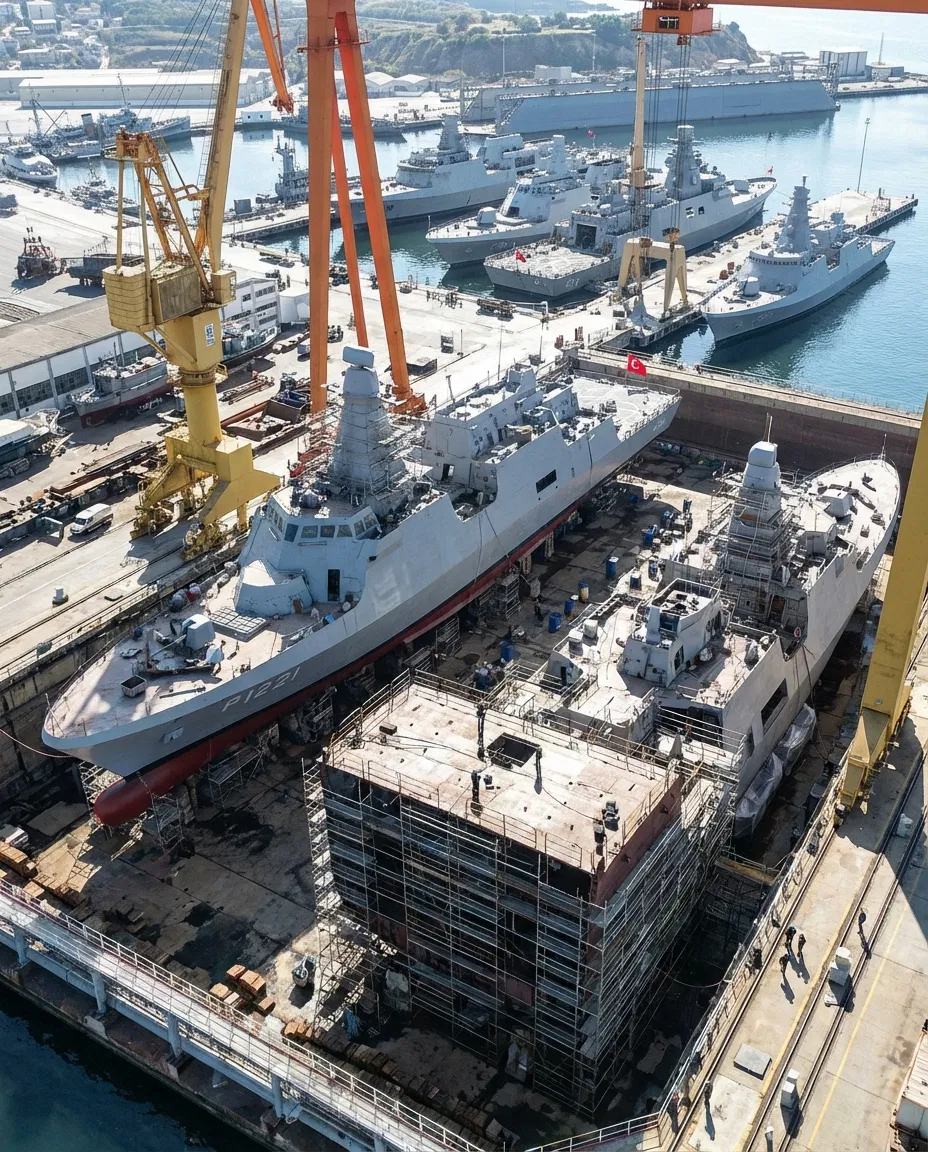
Turkey is advancing a massive naval construction program, with 46 military vessels under simultaneous development across several shipyards. This momentum covers platforms ranging from patrol craft to a new aircraft carrier, a project that stands as the largest of its kind in Europe.
The program includes 34 ships intended for the Turkish Navy and another 12 vessels being built for export markets such as Pakistan, Ukraine, Nigeria, Malaysia, Romania, and Portugal. These parallel production lines showcase the scale and ambition of Turkeys maritime industry.
Strategic planning over several decades has fueled this rapid expansion, delivering a national approach that prioritizes domestic capability and long term autonomy. Companies including Aselsan, Havelsan, and Roketsan have helped lift local content on naval platforms to between 75 and 80 percent.
Dozens of Advanced Platforms Under Construction
Current work spans a broad spectrum of naval projects, starting with the national aircraft carrier program MUGEM and expanding to H ISAR class corvettes, ISTIF class frigates, and new landing craft. Progress continues as well on MILDEN submarines and the extended Type 214 vessels that share lineage with those operated by Greece.
Additional programs include next generation minehunters, fast attack craft, and coastal tugboats, each contributing to Turkeys rising maritime infrastructure. These initiatives benefit from the involvement of private shipyards such as Sedef, Anadolu, and Sefine, whose participation has increased capacity and strengthened competition.
International Customers Drive Export Activity
Beyond domestic priorities, Turkey is also fulfilling a rapid sequence of international contracts. Recent deliveries include a MILGEM corvette handed to Pakistan, while two more vessels for Ukraine remain under construction.
Production continues as well on patrol craft and attack boats for Nigeria, with several platforms nearing delivery. Malaysia awaits three MILGEM corvettes scheduled for completion by 2027, and Romania is set to receive a fully equipped H ISAR class corvette in 2026.
Portugal is expected to receive two replenishment and logistics support vessels that are currently being assembled.
A Long Path of Strategic Investment
The roots of Turkeys shipbuilding strategy trace back to the aftermath of the 1974 Cyprus intervention, when an arms embargo underscored the risks of foreign dependence. This realization shaped a bipartisan policy to manufacture domestically whenever possible.
The MILGEM program, launched in 2004, became the catalyst for broader industrial expansion by moving from simpler Ada class corvettes to more complex Istanbul class frigates. Earlier co production arrangements with foreign partners helped build technical capacity and modernize shipyard infrastructure.
Parallel to platform development, Ankara invested heavily in indigenous systems including radar, combat software, and missile technologies, enabling high domestic participation and reduced reliance on foreign suppliers.
Greek Naval Policy Remains Unsettled
Greece has taken a markedly different path, relying on foreign shipyards for major acquisitions such as FDI Belharra frigates and used FREMM Bergamini vessels. This approach prioritizes fast procurement but leaves no lasting industrial footprint.
Domestic shipyards including ONEX have proposed national programs with significant Greek participation, yet these plans have not gained traction. Industry groups have also recommended a unified national effort, though decision making has not moved forward.
A key unresolved issue concerns the offer to construct the fourth FDI Belharra in Greece at a cost reportedly 10 percent lower than building abroad. No formal discussions with the proposing company have taken place, leaving questions about long term strategic planning and industrial policy.