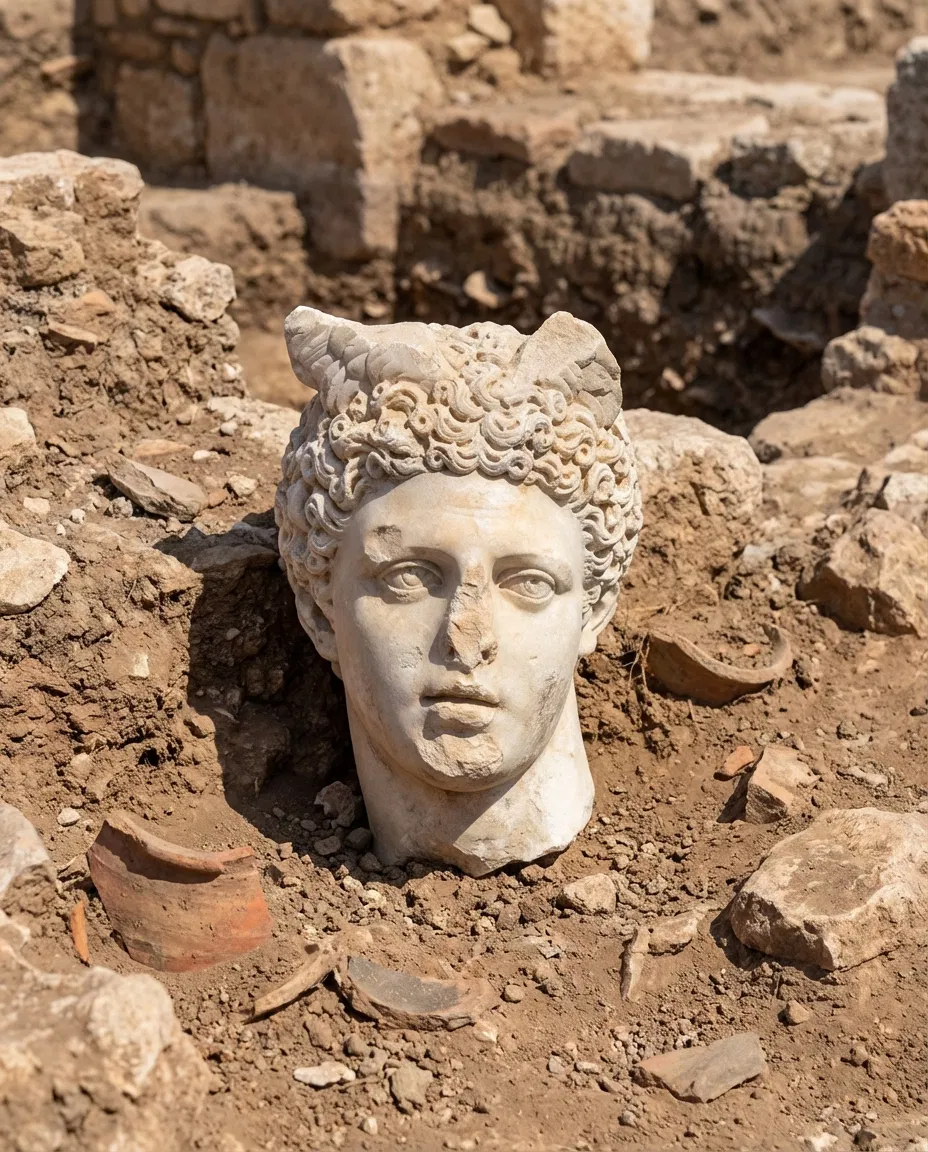

A finely crafted marble head of the god Hermes has been unearthed in the Ancient City of Laodicea near modern day Denizli in southwestern Turkey, offering new insight into the region’s artistic sophistication. Excavators uncovered the sculpture in the eastern entrance corridor of the Bouleuterion, the civic council building at the heart of the site.
The head is carved from high quality white Dokimeion marble sourced from the area of present day Iscehisar, a material renowned in antiquity for its purity and endurance. Preliminary analysis places the work in the mid 2nd century AD, a period marked by flourishing craftsmanship across Roman Anatolia.
Its delicate facial features, carefully shaped eyes and iris, and elegantly curled hair with distinctive wing motifs reveal stylistic influences associated with the classical sculptor Praxiteles. Specialists identify the piece as aligned with the Hermes of Andros type, a sculptural tradition prized throughout the Mediterranean for its balance and naturalism.
Such a find underscores Laodicea’s prosperity during the Roman Empire, when the city thrived as a commercial hub in the Lycus Valley. Its strategic position along major trade routes supported textile production, agriculture and a bustling market economy, which in turn financed grand public projects including theatres, colonnades, temples and administrative complexes.
Hermes held widespread symbolic importance as the messenger of the gods and guardian of commerce, travel, eloquence and transitions. His presence in a council building carries particular resonance, reflecting the values of communication, movement and civic order that shaped public life in the ancient city.
The discovery also reinforces Laodicea’s layered cultural identity, which blended classical traditions with its later significance as one of the Seven Churches of Asia. Public structures such as the Bouleuterion and the Prytaneion embodied both political prestige and the city’s commitment to the arts and architecture.
Conservation and documentation work is now underway to safeguard the sculpture and its architectural context. Archaeological efforts continue under the Heritage for the Future project, which prioritises the preservation of cultural assets while expanding public access to archaeological knowledge.
The marble head contributes significantly to the understanding of artistic production in Roman Anatolia, highlighting the dialogue between economic power, aesthetic ambition and civic identity. Ongoing research promises to further illuminate how artefacts like this Hermes express the enduring elegance of ancient craftsmanship and the stories it preserves.