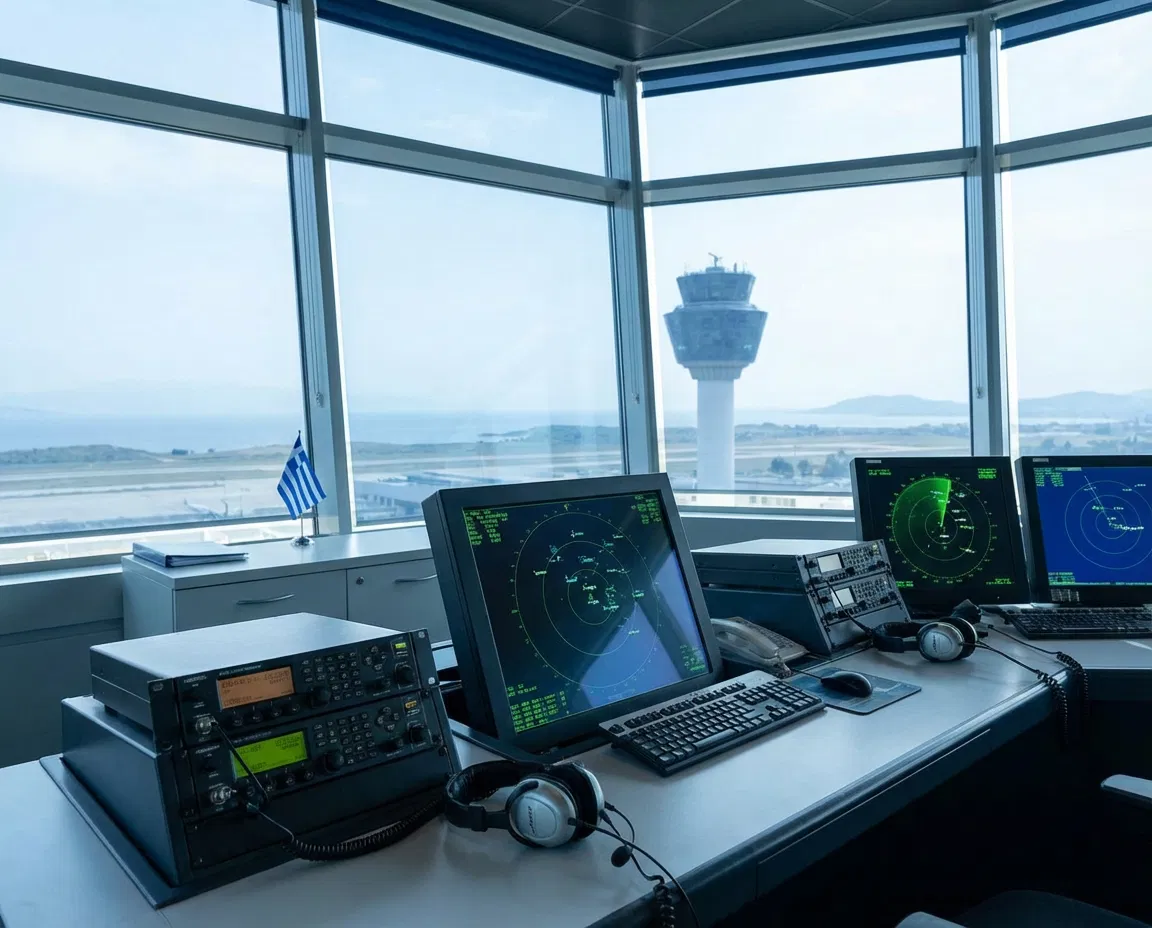

A Major Breakdown Reveals Deep Systemic Weaknesses
Experts examining the 4 January 2026 blackout in the Athens Macedonia Area Control Center reported that obsolete radio communication technology triggered the eight hour suspension of air traffic operations across the Athens FIR. Their findings highlight systemic risks that remain unresolved and could lead to similar incidents in the future.
The committee concluded that the Synchronous Digital Hierarchy system still used by the Hellenic Civil Aviation Authority no longer receives manufacturer support, leaving it vulnerable to failures without assurances of stability. Immediate replacement of the system was recommended as the only reliable safeguard against further interruptions.
Investigators also warned that both the outdated Voice Communication System and the telecommunications infrastructure provided to the authority rely on legacy technology that has reached the end of technical support. No operational guarantees can be offered while these components remain in place.
Warnings Ignored for Years
OTE had repeatedly notified the authority since 2019 that SDH, PCM, HELLASCOM and related circuits were no longer supported and needed to be replaced by E Line and IP VPN circuits. That warning did not result in timely action, according to the expert report.
A September 2025 assessment had already outlined severe shortcomings in the national air traffic control system, highlighting long standing delays in modernization efforts.
Who Took Part in the Investigation
An investigation committee led by Christos Tsitouras brought together representatives from the National Cybersecurity Authority, the Hellenic Armed Forces, the national telecommunications regulator, EUROCONTROL and an observer from the European Union Aviation Safety Agency.
The team identified the Hellenic Civil Aviation Authority and OTE as responsible parties and noted a level of cooperation between their technical teams that fell short of what was required.
How the Incident Unfolded
The disruption became apparent at 08:59 on 4 January 2026 when reduced radio communication capacity forced controllers to apply a Zero Rate restriction to the Athens FIR. That measure effectively halted air traffic to maintain safety.
The committee found that digital noise caused by desynchronized heterogeneous interfaces feeding into the Athens Macedonia Area Control Center installations triggered the failure. Multiple transmitters activated unintentionally, overwhelming the electromagnetic spectrum and impeding communication.
Transmitter activation across several major sites
Interruption of data links between the authority, the Air Force and foreign control centers
Partial failure of analog telephone connections
System restoration occurred gradually through interface restarts and resynchronization, though investigators said the absence of logs and error tracking made it impossible to pinpoint the exact cause.
Delays and Structural Weaknesses
The report emphasized that response delays stemmed from the lack of end to end telemetry and the insufficient collaboration between the two responsible organizations. The network operations center viewed circuits as functional even as critical links failed.
Experts added that outdated technology inherently limits monitoring capabilities, but cooperation between agencies remains an area that can and must be significantly improved to reduce the risks posed by aging systems.