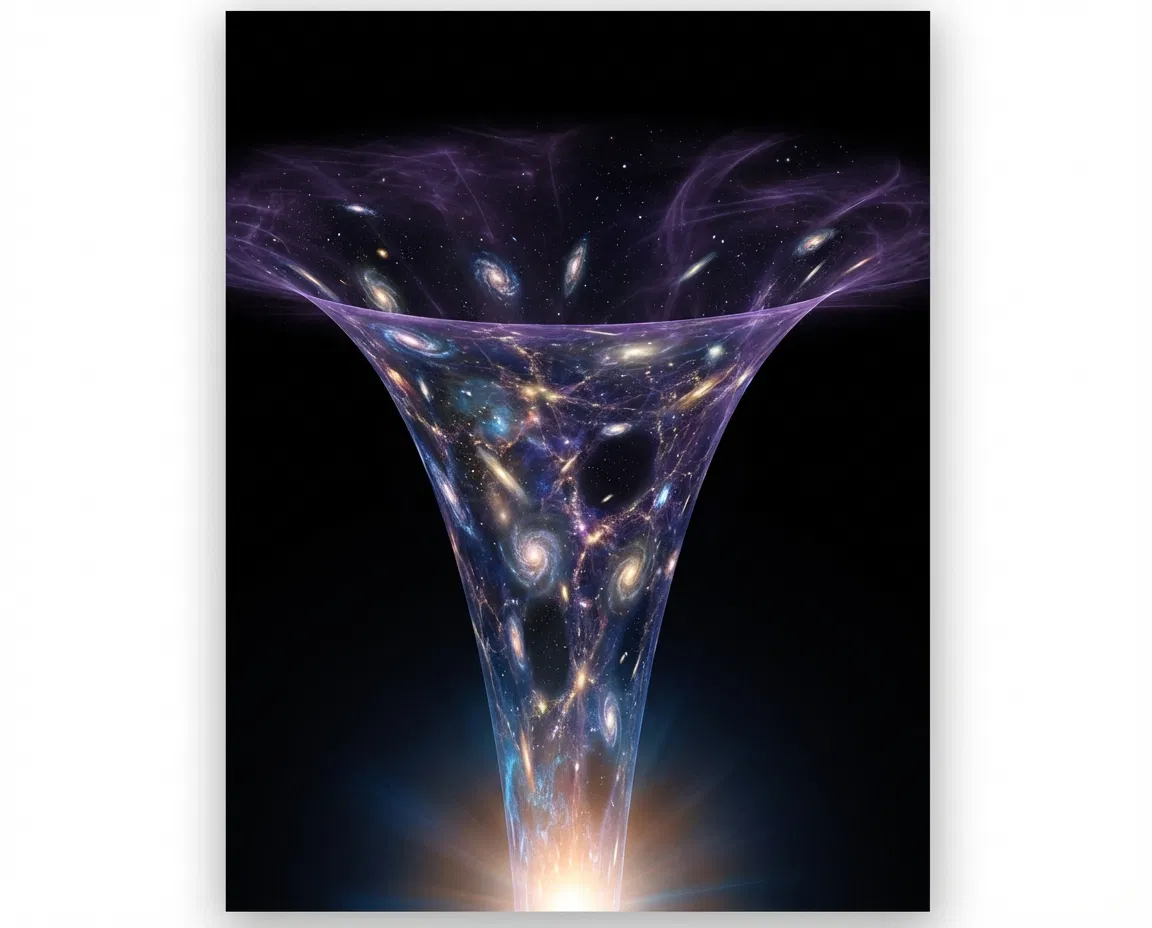

New observational analyses are prompting astronomers to reconsider long held assumptions about dark energy after emerging evidence suggested it may not remain constant. Fresh results point toward the possibility that the accelerating expansion of the Universe could be slowing a shift that would dramatically reshape modern cosmology.
Recent work by a research group in South Korea indicates that the expansion of the Universe might be losing pace potentially allowing gravity to reverse its outward motion. Their interpretation raises the likelihood of a future scenario known as the Big Crunch in which cosmic structures collapse back on themselves.
Independent measurements published this year underscored the potential magnitude of such a development with some of the scientists involved describing the moment as one that could signal a major turning point in contemporary astronomy. Other specialists urged caution while acknowledging that the data cannot yet be dismissed.
Background on dark energy
Astronomers long assumed the expansion that began with the Big Bang approximately 13.8 billion years ago should gradually slow because of gravitational attraction. Breakthrough observations of distant supernovas in 1998 overturned this expectation by revealing that galaxies were separating at an accelerating rate.
Those findings led to the proposal of dark energy an unknown force believed to drive this acceleration. Some theoretical models went further suggesting that continuous acceleration might ultimately culminate in a catastrophic Big Rip where even atomic structures would be torn apart.
Data that sparked renewed scrutiny
An unexpected twist arrived in March when the Dark Energy Spectroscopic Instrument located on a telescope in the Arizona desert delivered measurements that diverged from the standard cosmological model. DESI’s high precision mapping of millions of galaxies hinted that the expansion’s acceleration may have shifted over time.
Professor Ofer Lahav of University College London who is part of the DESI collaboration said that a rise and fall in dark energy would demand new physics adding that such a change could challenge the foundations of the field.
Further momentum came in November when the Royal Astronomical Society published a study from a South Korean team led by Professor Yong Wook Lee of Yonsei University. Their analysis re examined supernova observations while factoring in the ages of the host galaxies.
This refinement suggested that dark energy may have varied through cosmic history and that the Universe’s acceleration appears to be weakening. Professor Lee said that the fate of the Universe could shift if dark energy indeed diminishes arguing that such a development would alter the central framework of modern cosmology.
Possibility of a Big Crunch
Researchers noted that a weakening repulsive force could allow gravity to dominate eventually triggering contraction instead of perpetual expansion. Professor Lee said that a Big Crunch becomes plausible under these conditions though he emphasized that the final outcome depends entirely on the true nature of dark energy.
The South Korean study underwent peer review before publication but several leading astronomers remain skeptical. Cambridge professor George Efstathiou questioned whether the results primarily reflect the complexities inherent in supernova data and suggested that age based corrections introduce risks.
Despite this skepticism Professor Lee said his team’s conclusions draw on 300 galaxies and possess statistical significance so strong that he estimated the likelihood of randomness at approximately 1 in 1 trillion.
A debate still unfolding
The discussion intensified further when two additional research teams re evaluated the brightness of selected supernovas in an effort to reassess the initial DESI signals. Their work softened but did not eliminate the earlier indications even after extensive review.
Continued academic debate appears inevitable with hundreds of related papers already in circulation and views still sharply divided. RAS Deputy Director Robert Massey remarked that such disagreement is not necessarily detrimental noting that the ultimate goal is to understand how the Universe began and how it might eventually end